
Long Before the Rainbow
Why the LGBTQIA+ community constituted women’s sports and a look at the structure beneath the celebration.

An op-ed by TOGETHXR Co-Founder Jessica Robertson
Women’s sports were queer the whole time “no one” was watching. It was built and carried, in large part, by queer women and women of color long before the broadcast deals and the sold-out arenas ever arrived.
That’s structural. It’s not sentiment. To understand why women’s sports became one of the most reliably LGBTQIA+ spaces, you have to look at where it was made to live. For most of its history, women’s sports was pushed to the margins by sexism. By the assumption that women’s sports and female athletes were lesser, unserious, not worth a broadcast window or a sponsor’s money or a seat in the stands. In the U.S., Title IX forced a door open in 1972 and built the pipelines (the school teams, the college programs) at a scale that had never existed before. But the same disregard that had kept the games small kept them largely unwatched even as they grew: the cameras, the money, and the cultural spotlight stayed trained elsewhere, because the people who held them (the decision makers) did not believe women playing was worth seeing. And that neglect, for all its injustice, left room. The margin is where people who have been discarded go to build something of their own. Unsupervised. And so, a great deal freer than they would otherwise have been allowed to be.
What they were building, they built under a contradiction. On one side was suspicion, the long-running idea that a woman who competed too hard, who wanted her body to be powerful rather than decorative, wasn’t quite a proper woman at all. Call it what it was: gender-policing, a constant low-grade interrogation of who counted as a “real” woman, aimed at anyone who pushed against the narrow edges of the definition. On the other side was a reward. When the culture did turn to look, it wanted its women athletes legible and palatable through a patriarchal, heteronormative, and largely white lens: feminine, straight-presenting, easy on a Western eye. That standard was never only about gender. The femininity it prized was a white one, and women of color were measured against a womanhood that was never shaped with them in mind. They were expected to soften themselves into it, and discounted when they didn’t. For the women the standard favored, the pull wasn’t only imposed from outside; it was often genuinely desirable to be seen that way, because that was where the attention and the sponsorships and the lasting careers went. Athletes were rewarded for a safe, familiar femininity and scrutinized for any distance from it. None of this made women’s sports a utopia. For a long time, it asked plenty of its own people to make themselves smaller, quieter, or more conventional than they were in order to survive.
But here is the irony at the center of the whole story. The very suspicion that marginalized the women’s game also marked it, in the public imagination, as a place for the people who didn’t fit the template. And a space the world has decided is for the people who don’t fit becomes, almost inevitably, a refuge for everyone it pushes to the edge. The stigma built solidarity. People who had nowhere else to be fully themselves found one another on these teams and in these stands, and they stayed. But a refuge is not the same as safety, and it was never equally safe. Black and brown queer women often carried racism into the very rooms that sheltered them from homophobia, doing the work, absorbing the scrutiny, while the recognition, when it finally came, tended to land somewhere lighter. The sanctuary was real. It was also incomplete.
That is why the language of sanctuary fits women’s sports so precisely. For a great many people, the arena became one of the rare rooms where you could stop translating yourself. Where you could love who you love without first calculating the cost, where being seen turned into the freedom to be known, and that freedom, somehow, kept turning into joy. This is what queer communities have always understood about their gathering places, and why they protect them so fiercely: a place to be unguarded is not a luxury; it is survival. This community also knows what it costs when one of those places is taken. Ten years on from the night a dance floor in Orlando became a place of grief, that knowledge still sits close to the surface.
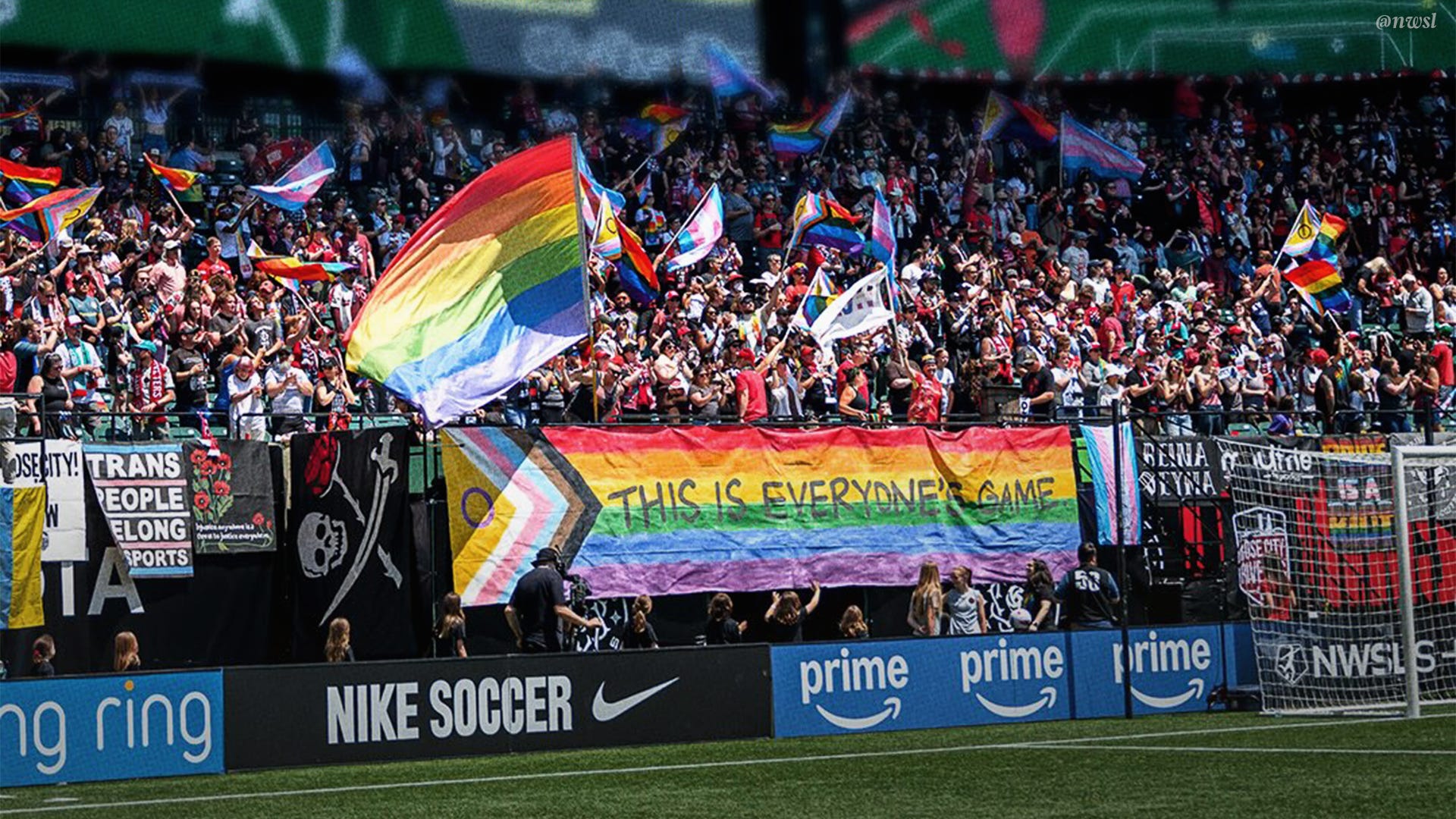
And so the community keeps building these places wherever it can. In locker rooms and on team buses, in the stands, in every room it has ever filled to watch the game together. When one refuge is lost, another gets made, because the people who need them have never been able to assume that a place to belong would simply be waiting for them. They have always had to build it themselves. Here, chosen family isn’t a metaphor; it’s the practice the whole thing rests on.
And it has never been a single-axis community. When Kimberlé Crenshaw coined the term intersectionality in 1989, she was describing precisely what disappears when you treat race and gender as separate problems; the lives of people who exist at the crossing of both at once. Women’s sports is that crossing made flesh. It is a world made and led largely by women of color, by queer women, by trans and nonbinary people, where nobody has ever had the option of being only one thing at a time. It doesn’t study intersectionality from a distance. It fields it.
All of which makes the present moment less abstract than it looks. The machinery now being used to police trans women in sport, defining “real” womanhood by biology, demanding that women submit proof they belong, narrowing the word woman until it fits inside a statute, from one country’s lawbooks to the next, is not new. It is the same gender-policing the women’s game has absorbed for as long as it has existed, widened to take in a new group. Sport has always guarded the borders of womanhood, and it has always reached first for the women furthest from a white, Western picture of it. That is to say, anyone whose body or bearing the gatekeepers decided to doubt. Trans women are the newest name on a very old list, and the logic is the one it has always been: a narrow idea of who is allowed to be called a woman. This community recognizes the move because some part of it has always been on the receiving end of it. A space that was told for generations its women weren’t “woman” enough is not about to turn around and say the same thing to anyone else.
So pride here at TOGETHXR isn’t decoration, and it isn’t a marketing window. It’s a position held by a community that arrived at it the hard way.
Here, women has always meant all women. Trans women are women. Not the polite addition at the end of the sentence. The sentence itself.
Rainbows in June here aren’t a decoration. They mark a community that was queer before it was watched, that loved this game into existence long before it was ever loved back.
Pride didn’t come to women’s sports. Pride is women’s sports.
we all deserve sunshine 🏳️🌈🏳️⚧️🫶🏾